Intersections
Civic engagement for equity doesn't only happen at the ballot box. Sometimes it happens at a microphone in a committee room, with legislators listening and the public record open. The testimonies on this page represent Dr. Clark's commitment to showing up wherever decisions about communities are being made — not to score political points, but to insist that history be told truthfully, that evidence be heard, and that the people most affected by policy have a voice in shaping it.
Justice and equity are not abstract ideals — they are built, piece by piece, in the everyday acts of speaking up, sharing knowledge, and refusing to let consequential decisions be made without community voices in the room. Whether testifying before a legislative committee, presenting research on the systems that shape people's lives, or putting civic tools directly into the hands of communities that need them, everything on this page is an act of that same ongoing work.
Testimony
Bringing community knowledge and research into legislative hearing rooms
Research & presentations
Translating findings into forms that travel beyond the academy
Free resources
Putting civic and career tools directly into the hands of communities
Florida Senate Rules Committee · SB 308 · February 2026
On the Florida Museum of Black History — SB 308
Florida authorized the creation of a state Museum of Black History in 2023, and after a year-long site selection process, St. Johns County was designated as its home. A welcome development — on its face. But a museum is only as honest as the people who control what goes inside it. Under SB 308, that power rests with a 13-member Board of Directors appointed by the Governor, the Senate President, and the House Speaker. The same Governor who has publicly opposed the teaching of Black history in Florida's classrooms.
Not opposition to the museum — but an insistence that the institution be held to the standard its mission demands. A museum of Black history that softens, omits, or sanitizes that history is not a museum. It is a monument to comfort. The Senate passed SB 308 unanimously. The House never took it up, and the bill failed — leaving both the museum's future and the question of who will tell its story unresolved.
Florida House Education & Employment Committee · HB 999 · April 19, 2023
On House Bill 999 — DEI, Academic Freedom & Higher Education
HB 999 was one of the most sweeping attacks on higher education equity in Florida's recent history. The bill sought to ban funding for DEI programs entirely, prohibit academic majors in fields like critical race theory, gender studies, and intersectionality, strip faculty committees of their role in hiring decisions, and reorient general education requirements around Western civilization — while authorizing boards of trustees to review faculty tenure at any time.
"History and culture are not a buffet that you can pick and choose from."— Dr. Allison Clark, House Education & Employment Committee, April 19, 2023
HB 999 did not pass as written — but its core provisions were absorbed into Senate Bill 266, which was signed into law. The impact on Florida's public universities was real and lasting. Dr. Clark's testimony placed evidence in the record at a moment when evidence was most at risk of being legislated away.
Florida House Select Committee on Congressional Redistricting · HB 1D · April 28, 2026
On Mid-Decade Redistricting — Florida's Legacy of Malapportionment
In April 2026, Governor DeSantis called a special legislative session to redraw Florida's congressional map — not after a census, not under a court order, but as part of a presidential push to maximize Republican seats ahead of the midterms. The map stood to shift Florida's congressional delegation from 20-8 Republican to 24-4. The House passed it 83-28. The Senate followed on largely partisan lines.
Before the House Select Committee on Congressional Redistricting, bill sponsor Representative Jenna Persons-Mulicka was represented by two men who presented on her behalf: Jason Poreda, the DeSantis staffer who drew the map, and Mohammed Jazil, an attorney for the Governor's office. It was Poreda and Jazil who cited Florida's 1885 maps and constitution before the committee — invoking them as if they were a sound foundation rather than the origin of a system designed to erase Black political power.
Representative Bruce Hadley Antone moved to have Poreda and Jazil sworn in before their presentation. The committee chairman refused. With over 100 citizens signed up to speak and the Chair asking those remaining to cut testimony to roughly 30 seconds, Dr. Clark made a choice: not to repeat what had already been said, but to place the moment inside the history that made it possible.
She spoke for approximately 36 seconds. Not a deep dive into each era, but an uplifting of the arc — Reconstruction, the 1885 Constitution, the Pork Chop Gang, and the present. The throughline, named.
Florida's legacy of malapportionment has a precise starting point: the 1885 Constitution. It was not the beginning of Florida's political history — Reconstruction's 1868 Constitution had briefly opened the door, giving Black men the right to vote and sending Josiah Walls to Congress in 1870. The 1885 Constitution was the deliberate slamming of that door. It capped representation for populated counties, ensuring that a minority of voters in rural, white-dominated areas could elect a legislative majority. That was the architecture Poreda and Jazil were citing as precedent. Dr. Clark's research made clear what it actually was: the codified beginning of a harm that never fully ended. Through the Pork Chop Gang's frozen maps, through decades of malapportionment, through the Fair Districts Amendments that 63% of Florida voters passed in 2010 to ban exactly this — the line runs straight to 2026.
Florida's Fair Districts Amendment bans partisan gerrymandering; DeSantis has appointed six of the Florida Supreme Court's seven current members.
📰 Florida Politics coverage, April 2026 View testimony documentation →Equity work does not end when the hearing room empties. These presentations, videos, and free resources extend the same commitment — putting civic knowledge, career tools, and research findings into the hands of the communities that need them most, with no barriers to access.
Archival Interview · STEM DEI · c. 2010
An Interview with Allison Clark — Origins of a Career in STEM Equity
Recorded during her tenure at the National Center for Supercomputing Applications, this interview captures Dr. Clark reflecting on the serendipitous path from psychology to high-performance computing, articulating the STEAM philosophy, and speaking directly to young people from underserved communities. The intellectual roots of everything that followed.
Archival recording, circa 2010
Watch the interview →
Free Resource · STEM Careers · Youth
STEM Career Exploration Booklets
Two free downloadable booklets designed to put STEM career exploration directly into the hands of young people and the educators and community members who support them. Rooted in the belief that STEM belongs to everyone — no registration required, no barriers, just download and share.
Download free booklets →
Leadership Training · Civic Education · 2020
Take the Lead: A Black Leaders Training Series
Presented for Equal Ground in 2020, this leadership development training was designed for Black leaders ready to step into civic and political life. Dr. Clark guided participants through the DNA of leadership: personal story, leadership style, leading through crisis and pain, coalition-building, and sustaining yourself for the long fight.
View the presentation →
Nonprofit Law · Civic Education · PDF
501(c)(3) Regulations — Know Your Rights
A practical presentation on the laws governing 501(c)(3) nonprofit organizations — essential knowledge for community groups, organizers, and advocates who want to understand the legal framework within which their civic work operates. Because knowing the rules is the first step to using them.
View presentation →
Civic Education · STEM & Democracy · 2020
blackcomputeHER: From COVID to Kanye
In 2020, Dr. Clark brought her research directly to the women of blackcomputeHER — data scientists, machine learning professionals, and STEM leaders — with a message most civic presentations miss: your technical expertise is a civic asset. This presentation mapped the landscape of voter suppression facing Black communities — from international interference to domestic obstacles including COVID-19's disruption of poll workers, reduced voting hours, and precinct relocations. It also raised a pointed question about the signature verification software used in vote-by-mail systems: if the training data reflects existing racial bias, does the algorithm suppress Black votes? The intersection of STEM expertise and civic responsibility has never been more urgent — and this presentation made the case directly to the people best positioned to do something about it.
View presentation →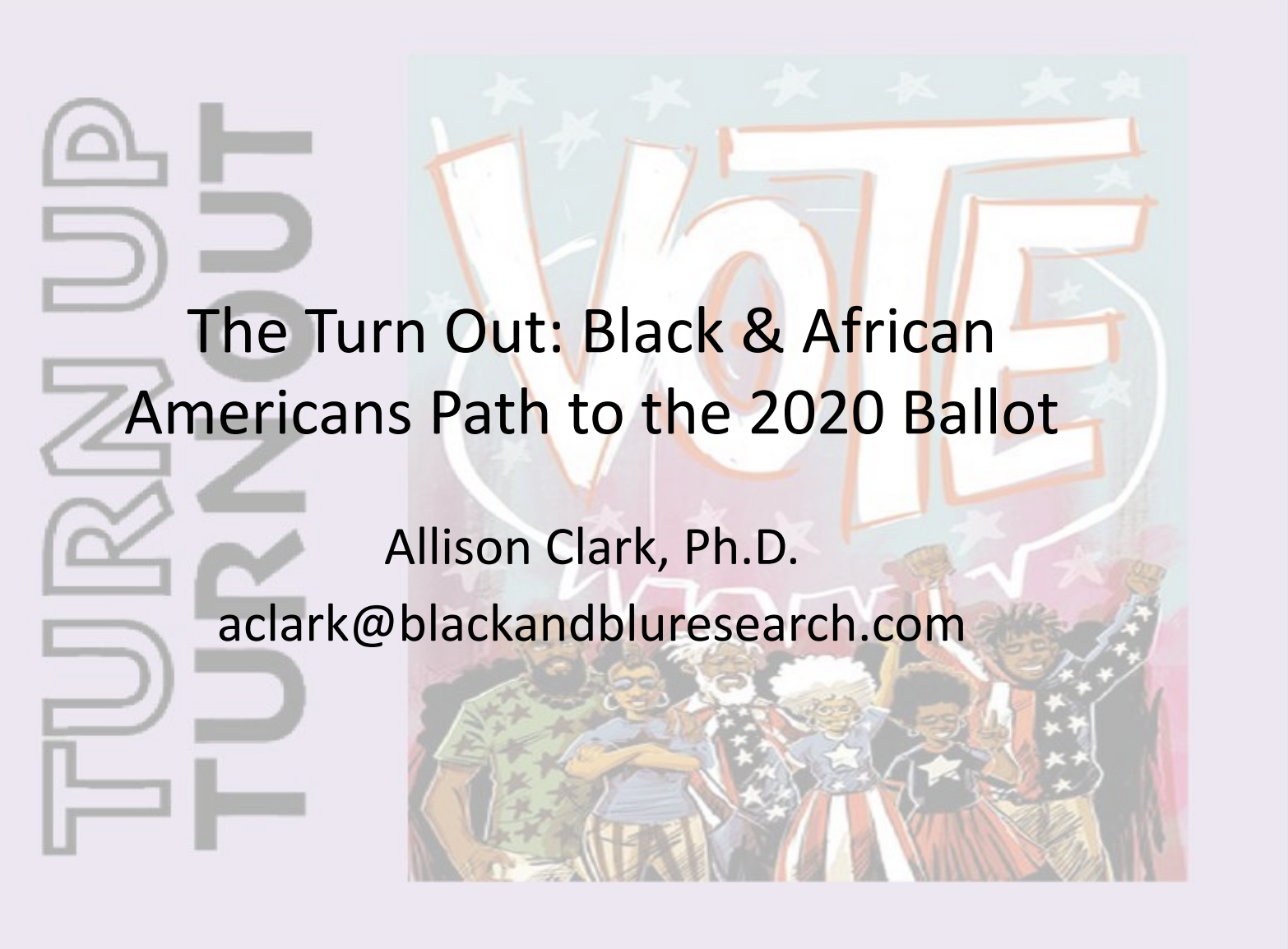
Civic Education · Voter Mobilization · 2020
The Turn Out: Black & African Americans Path to the 2020 Ballot
Delivered to members of the National Association of Black Engineers, this presentation built on a foundational conviction: voting IS Black culture. Dr. Clark guided audiences through the full architecture of the 2020 election — vote by mail, early voting, curing a provisional ballot, tracking your ballot, and knowing every deadline. She grounded the urgency in data: the Hillsborough County State Attorney's race was decided by 4,719 votes out of more than 570,000 cast — 50.41 to 49.59. One race. Thousands of votes. Everything changed. The presentation also introduced the Turn Up Turn Out Voting Information App — covering all 67 Florida counties — and called on this group of STEM professionals to step into their role as family experts, equipped to combat misinformation and hold electoral systems accountable. The closing call: stay the course. Be diligent.
View presentation →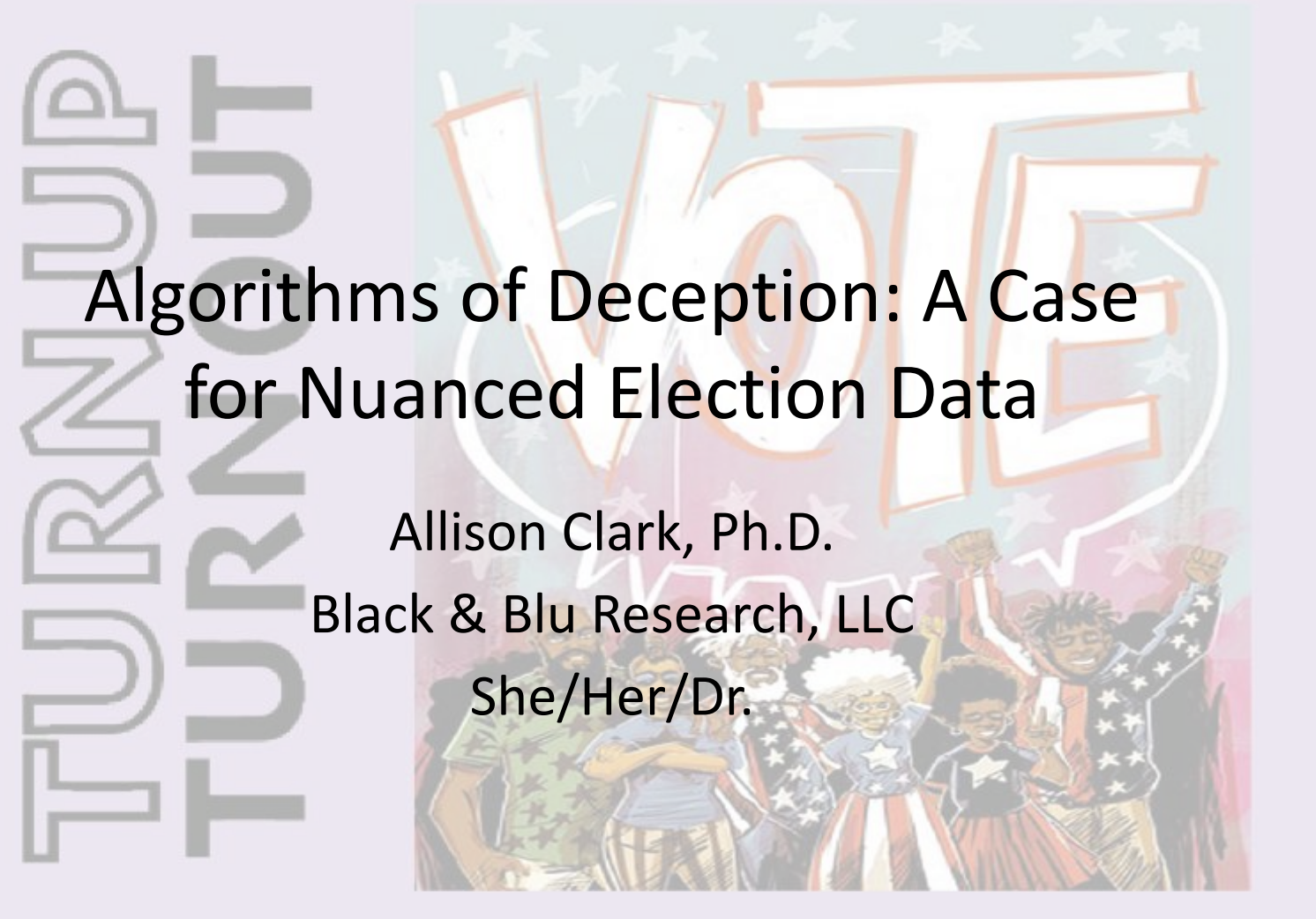
Civic Education · Voter Mobilization · Research
CMU Presentation
This presentation by Dr. Allison Clark of Black & Blu Research, LLC, discusses strategies for effective voter mobilization and civic engagement, focusing on the use of data, culturally competent messaging, and addressing systemic obstacles to voting.
View presentation →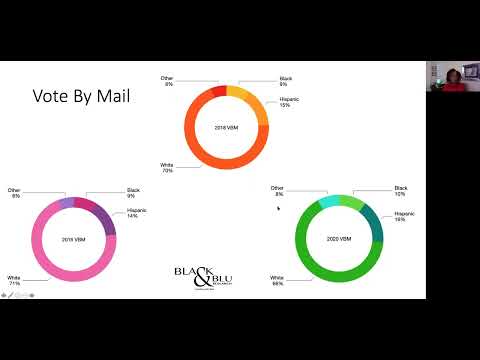
Research · Electoral Analysis · 2020
2020 Election Results in Florida
A research-driven analysis of the 2020 Florida election results, documenting voter turnout, community mobilization outcomes, and the impact of civic engagement campaigns across all 67 counties.
View research →Research · Presentations · 2020
2020 Election Presentations
A collection of presentations documenting the strategies, findings, and community outcomes from the 2020 election cycle — including data on voter registration, civic engagement, and the reach of the Turn Up Turn Out Vote campaign.
View presentations →Every testimony, every presentation, every free booklet on this page is an answer to the same question: who gets to be part of the conversation? Dr. Clark's answer has always been the same — everyone. Especially those who have been told, implicitly or explicitly, that the rooms where decisions are made were not built for them. That is the intersection this page lives in: between what is, and what ought to be.